I Took 43 Pilates Classes as a Strength Coach. Here’s What I Learned.
And I’m on a mission to get a barbell in every woman’s hands. After my career in powerlifting, I’ve spent the last decade educating millions of people on how to get stronger and build confidence in a world that’s focused on shrinking them.
I now coach 25,000+ women inside my strength training app, and this blog is where I share the conversations, lessons, and questions worth digging into a little deeper.
Hi, I'm meg

Pilates is everywhere right now.
Scroll Instagram for five minutes and you’ll be told – explicitly or implicitly – that you need to be doing Pilates. And somewhere along the way, Pilates girls and strength training girls started getting pitted against each other.
So let me start with a confession: I was a Pilates hater.
Not casually skeptical. Not “maybe it’s not for me.”
Full-on, “this is not a workout” energy.
I love lifting heavy weights, and I’ve been teaching other people how to do it as a coach for the last 10+ years. I don’t believe Pilates is a replacement for strength training, and I’ve never believed the resistance was high enough to meaningfully build strength or muscle.
So when one of the strongest, most successful powerlifters and bodybuilders I personally know – Ryan Doria (aka @thenattypro) – became a Pilates fanatic (so much so, I thought he was an instructor), I was confused. Genuinely confused.
What did he know that I didn’t? 🤔
That question turned into a challenge:I would take a Pilates class every single day and see what actually happens; to my body, my strength, and my perspective.
The Rules of the Challenge
- Pilates nearly every day
- Continue strength training 3 days per week (down from my usual 4)
- No “blending” the methods… Pilates stays Pilates, lifting stays lifting
- Pre- and post- challenge tests of a few exercises (details below) to see if the Pilates challenge has carry over to any specific strength movements
I wanted to know:
- Would my core actually get stronger?
- Would Pilates improve movements I care about, like pull-ups or hollow body holds?
- Was there anything Pilates offered that I was missing?
Day One: A Rough Start
My first class was a group barre-style Pilates class.
One hour later? Honestly… it felt like a waste of time.
I wanted to like it. I really did. But it confirmed every bias I had walking in.
So I changed the plan.
If I was going to do this seriously, I needed coaching, real coaching. I signed up for private sessions, knowing they were expensive, but also knowing I needed eyes on me to actually learn the method correctly.
That was the right move – everything changed once I shifted strategies.
Classical Pilates vs. Contemporary Pilates (This Matters)
This is where a lot of confusion comes from, and why Pilates has a branding problem IMO.
In my early private sessions, I was introduced to classical Pilates, which stays close to what Joseph Pilates originally taught. This meant working on equipment like:
- The reformer
- The tower
- The wonder chair
- The ladder barrel
The focus in these sessions wasn’t burning calories or “feeling the burn.”
It was control, precision, breath, and flow.
After a few private sessions with this base, I took many contemporary Pilates classes – think mega reformers, high tension springs, sweatier, faster-paced, full-body circuits with squats, lunges, and arm work.
And here’s my hot take:
The farther Pilates moves away from its classical roots, the less compelling it becomes – at least, for someone like me.
What Pilates Is Not
Let’s clear this up.
Pilates is not strength training.
And, it was never meant to be.
The six core principles of Pilates are:
- Centering
- Concentration
- Control
- Precision
- Breath
- Flow
Notice what’s missing?
Progressive overload. Mechanical tension. Intensity thresholds required for muscle growth.
That doesn’t make Pilates bad.
But it does make it different.
Calling Pilates “strength training” creates unrealistic expectations, and disappointment when people don’t see strength or muscle gains.
What Pilates Actually Gave Me
Somewhere around class 12, something clicked.
Every single class had moments where I was shaking, close to failure, and deeply challenged… just not in the way I was used to.
Pilates gave me:
- Core control I didn’t realize I lacked
- Better awareness of pelvic, rib, and hip positioning
- Exposure to the concept of flow; something I had never trained intentionally
Flow explains a lot about why dancers gravitate toward Pilates. Movements transition smoothly, with control and intention. It’s graceful. Almost balletic.
Is that necessary for strength training? No.
Is it interesting, novel, and kind of fun? Yes. I really enjoyed training with that in mind.
The Tests: Did Anything Carry Over?
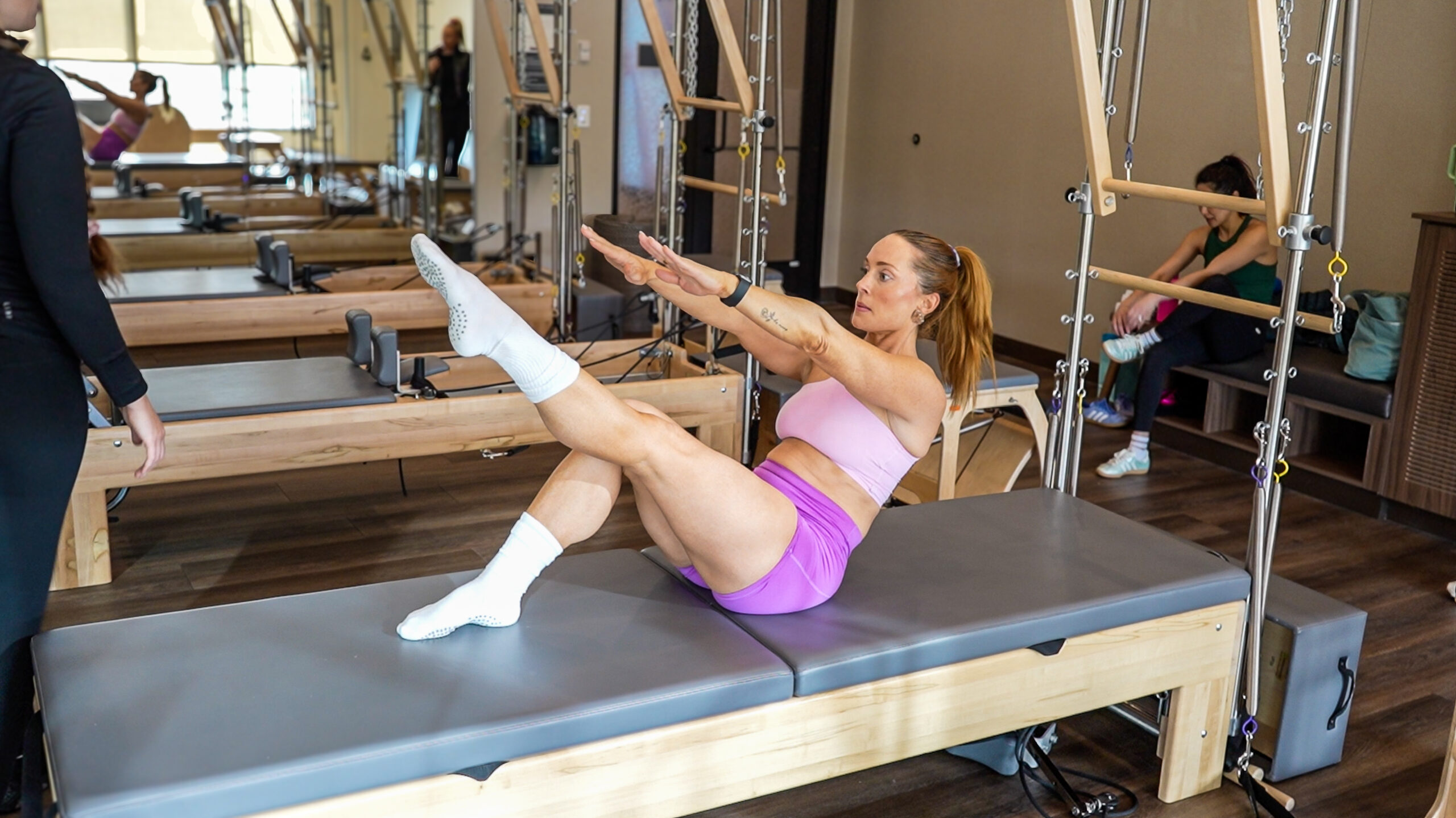
The Teaser
This became my Pilates-specific goal movement.
After 43 classes, my teaser improved significantly. More control, better tempo, smoother transitions. This is where Pilates shines; you progress within the practice itself.
Pull-Ups & Hollow Body
Minimal carryover.
Exactly what I expected.
My pull-up strength stayed roughly the same, which honestly surprised me given how much lifting volume I had to cut to fit in Pilates.
L-Sit
This one shocked me. I went from barely being able to attempt it to holding it with control. Shaky, yes, but controlled.
This was the clearest example of Pilates transferring to something outside the practice.
Was it worth 43 hours of Pilates for that improvement?
Probably not, from a pure efficiency standpoint.
My Main Takeaways
Pilates is cool. Cooler than I thought.
But it is not strength training, and it shouldn’t be marketed as such.
Pilates works best when you treat it like a practice, similar to yoga:
- You improve control
- You refine movement
- You progress within its own system
If your goal is:
- Fat loss ➡️ then lift weights + eat in a calorie deficit
- Muscle growth ➡️ then lift weights
- Bone density ➡️ then lift weights
If you’re drawn to:
- Control
- Precision
- Grace
- Core awareness
- Something entirely different from lifting
Pilates might be worth exploring… especially classical Pilates.
Should Gym People Do Pilates?
Try it if you’re curious. Say yes if invited.
But if your goal is core strength alone, there are far more efficient ways to train it.
Should Pilates People Lift Weights?
Absolutely. No question.
Pilates practitioners already have incredible body awareness, balance, and control; things that are notoriously hard to teach under a barbell.
Add even one day a week of heavy compound lifts, and you’ll improve:
- Strength
- Bone density
- Long-term resilience
And yes, it will likely make your Pilates practice better too.
The Bottom Line
Pilates and strength training are not enemies.
They’re just different tools.
The mistake is trying to make one pretend to be the other.
After 43 classes, here’s what I know for sure: Pilates isn’t for replacing strength. It’s a different practice, with different goals – and it works best when you let it stay that way.
Be the first to comment