Eating According to the USDA Guidelines (Past & Present)

And I’m on a mission to get a barbell in every woman’s hands. After my career in powerlifting, I’ve spent the last decade educating millions of people on how to get stronger and build confidence in a world that’s focused on shrinking them.
I now coach 25,000+ women inside my strength training app, and this blog is where I share the conversations, lessons, and questions worth digging into a little deeper.
Hi, I'm meg

If you grew up in the ’90s, you probably remember the giant food pyramid hanging in your classroom. The base? Bread. So much bread.
Over the last 35+ years, the USDA dietary guidelines have gone through multiple glow-ups — from the original pyramid, to MyPyramid, to MyPlate, and now the newest 2026 version.
So what happens if you actually eat according to them?
Let’s break down each era — what it emphasized, what changed, and what it means for you as someone who lifts, trains, and cares about performance (not just checking food group boxes).
1992: The Original Food Pyramid
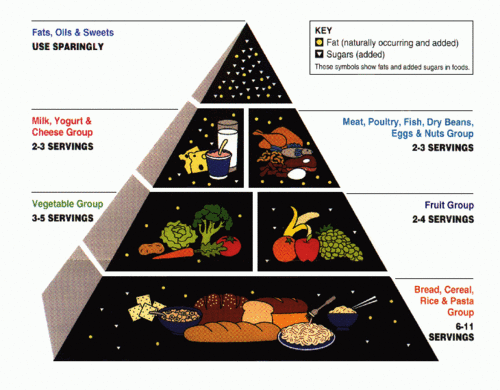
The vibe: Carbs first. Questions later.
At the base of the pyramid?
6–11 servings of bread, cereal, rice, and pasta per day.
Above that: fruits and vegetables.
Then: dairy and protein.
At the tiny little top: fats and sweets — “use sparingly.”
If you follow it strictly, your day ends up looking like:
- High grain volume
- Very low fat
- Moderate protein
- Tons of total food volume
One major criticism? It didn’t distinguish between refined grains and whole grains. White bread and whole wheat pasta lived in the same category.
And here’s something important: the guidelines are created jointly by the United States Department of Agriculture (USDA) and the Department of Health and Human Services (HHS).
The USDA promotes American agriculture.
So when recommendations say “eat more grains,” it’s fair to ask:
Is this purely public health… or is it influenced by agricultural economics too?
Nutrition advice doesn’t exist in a vacuum.
2005: MyPyramid
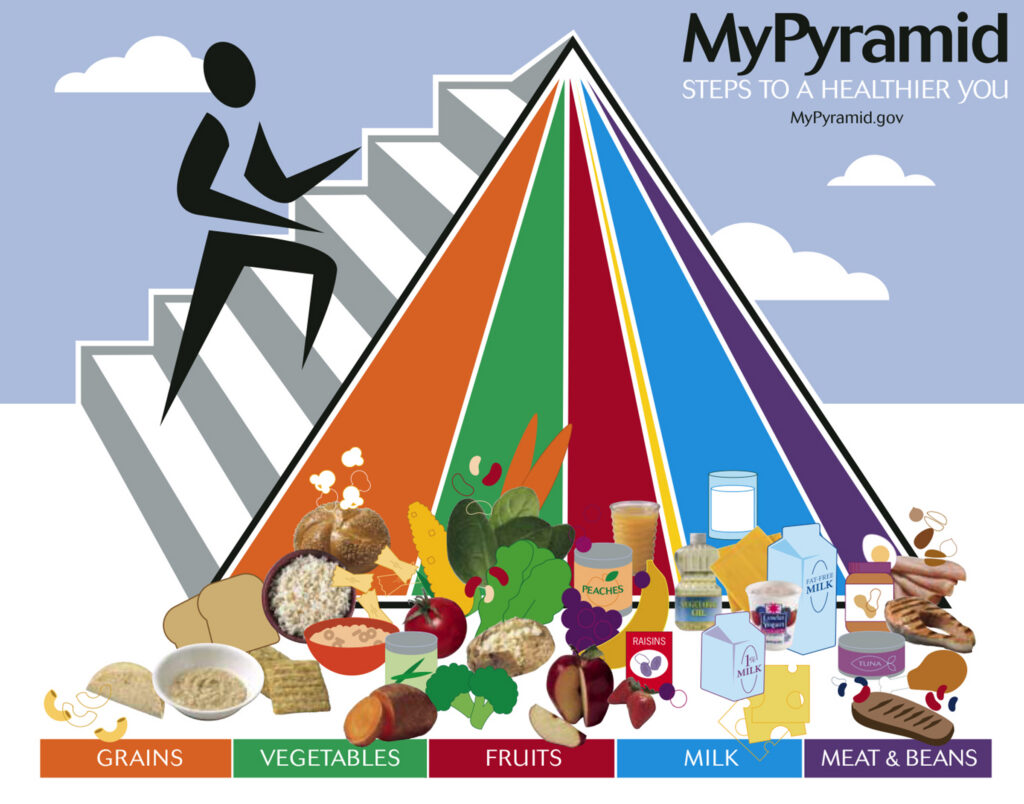
This was the abstract, color-striped pyramid with the little stick figure climbing the side.
Two major changes:
- No clear food hierarchy
- Physical activity explicitly included
You were supposed to go online, input your stats, and get customized recommendations.
On paper, it looked modern.
In reality? It was confusing.
Fat intake was very low. Hitting adequate calories — especially if you train hard — required dipping into “discretionary calories.”
For active women lifting 3–5 days a week, this often meant:
- Not enough total calories
- Not enough dietary fat
- Harder time supporting strength and recovery
Technically “balanced.”
Practically? Not super intuitive.
2011: MyPlate
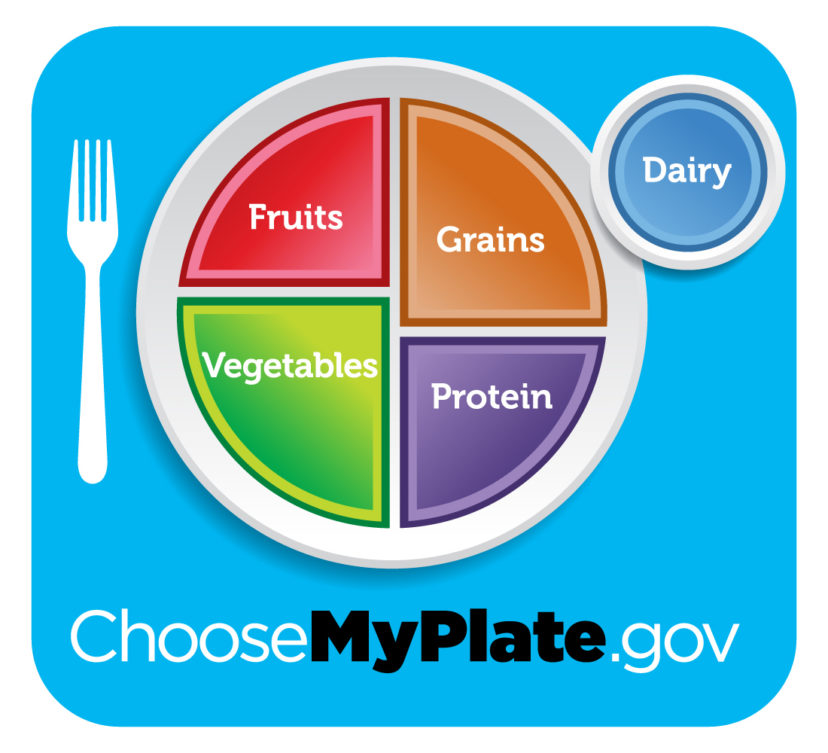
This is the one most people recognize now.
The pyramid was replaced with a literal plate:
- Half fruits and vegetables
- One quarter grains
- One quarter protein
- Dairy on the side
At a glance, it’s simple. Build your plate like this.
But here’s where things got messy.
When the Dietary Guidelines update, federal programs — including school lunches — must comply. Food manufacturers lobbied heavily during this era.
Yes, this is the period when tomato paste on pizza was allowed to count as a vegetable serving in schools.
Nutrition guidance isn’t immune to politics.
That doesn’t mean it’s useless — it just means it’s not purely science-driven.
2026: The Newest Guidelines
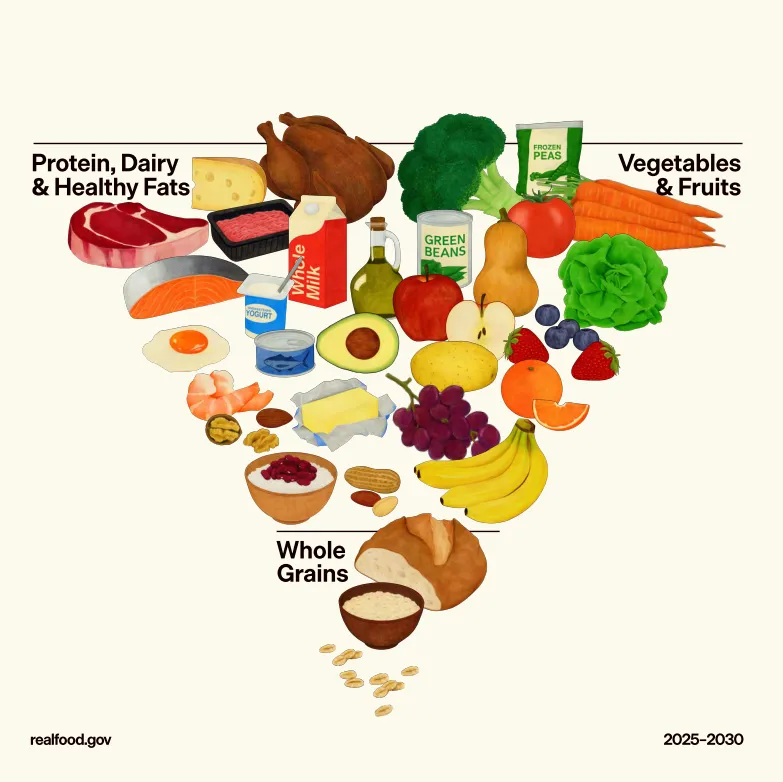
The newest version leans harder into:
- Whole foods
- Fruits and vegetables
- Higher protein emphasis
- More acceptance of full-fat dairy
- Continued guidance to limit saturated fat
But here’s the tension:
If you emphasize:
- Steak
- Butter
- Beef tallow
- Whole milk
You can very quickly exceed recommended saturated fat levels.
If you emphasize:
- Olive oil
- Avocado
- Fatty fish
- Nuts
You stay within recommendations more easily.
It’s not that one food is “good” or “bad.”
It’s about patterns and proportions.
The Bigger Question: Should You Eat According to the USDA?
Here’s the truth:
All four versions are generally reasonable, common-sense nutrition frameworks.
They encourage:
- Produce
- Fiber
- Protein
- Moderation with added sugars
- Awareness of fats
That’s not radical.
But they are designed for:
- The general public
- Population-level disease prevention
- Broad simplicity
They are not optimized for:
- Maximizing strength
- Building muscle
- Athletic performance
- Body recomposition
If you lift, your needs may differ:
- Higher protein
- Higher total calories
- Adequate fats for hormone health
- Strategic carbs around training
The guidelines aren’t wrong.
They’re just not personalized.
What I Recommend Instead
Use the USDA guidelines as:
- A baseline for overall health
- A reminder to eat produce
- A check against extreme diets
But build your actual nutrition around:
- Your activity level
- Your recovery needs
- Your training goals
- How you feel
Performance nutrition isn’t anti-government.
It’s just individualized.
You don’t need to rebel against the pyramid.
You just don’t need to worship it either.
Want More Practical Strength Nutrition?
If you’re trying to:
- Lift heavier
- Build muscle
- Fuel your workouts
- Stop overthinking every ingredient
Start here:
- 📺 Watch my YouTube breakdowns on nutrition myths
- 💪 Follow a structured lifting program like Stronger by the Day
- 📬 Join the newsletter for weekly deep dives like this
Because nutrition shouldn’t feel political.
It should feel powerful.
And it should support the life — and strength — you’re building.
This Substack is where I think out loud.
My email list is where I go deeper.
RSS Feed Link: https://megsquats.com/feed
Be the first to comment